an amazing experience

DSC_6606Yesterday, I had the privilege of visiting a Duffy’s Cut archaeological dig site thanks to Dr. William Watson of Immaculata. This is my second Duffy’s Cut tour thanks to the good doctor.13592353_10154326569529313_2829693570295626942_n

I also had the opportunity to meet his team, his brother, and the  teachers attending the National Endowment for the Humanities (NEH)  Duffy’s Cut Teachers Institute. Everyone was so warm and welcoming to a non-educator.

I have always wanted to see what an archaeological dig was like in real time, so I found it all fascinating!

Thanks Bill for including me!!!

Here is the PBS video of a few years ago. I have watched it a few time now and it still gets me every time – really powerful stuff:


DSC_6512 DSC_6551 DSC_6624 DSC_6651 DSC_6653 DSC_6670 DSC_6676 DSC_6702 DSC_6713 DSC_6741

chester county books


I admit it, I love books.

And I have been on the hunt for the three books you see pictured above for a while, and now I can say I have added them to my library.

These three fabulous books (Forty Years of Days, Chester County & Its Day, and Barns of Chester County Pennsylvania) were all written by a Chester County treasure named Berenice M. Ball

Once upon a time, the late Mrs. Ball was a long time Chairman of Chester County Day.  As a matter of fact her former home was on the 2015 Chester County Day house tour which benefits the Chester County Hospital Foundation.

I am pretty sure Chester County Day   is one of the longest running house tours in the nation, if not the longest.

Mrs. Ball published these fabulous books in the 1970s and 1980s. 1970 (Chester County and Its Day), 1974 (Barns of Chester County), 1980 (Forty Years of Days).

The books are full of old photos, sketches, history, anecdotes. Famous Chester County properties, even ones familiar to us today, are in these books. Like the often discussed Bryn Coed Farm, once home to Justice Owen J. Roberts.

Yes that Bryn Coed in West Vincent. It was restored back in the day by R. Brognard Okie.  I only knew the property made Chesterbrook look tiny, but I had non idea about Justice Robert’s actual home. I love Okie houses.

  Reading Chester County and Its Day it was interesting to learn that once upon a time this property Bryn Coed was a favorite on the Chester County Day circuit.

“Can anyone who ever saw Mr. Justice Owen J Roberts forget him in his country tweeds, standing in the driveway, pipe in hand, greeting each guest as if he were a visiting ambassador or posing for a picture after picture with groups and individuals? What a truly great human being he was and what good friends of the Day they both were.”

Given the constant discussion of the potential of development at Bryn Coed this sent chills up my spine!

Forty Years of Days has at the end of  it a complete listing of homes and landmarks open on Chester County Day between 1936 and 1980.

You can find these books on Amazon and eBay and in secondhand shops if you’re lucky. They were all produced back in the day as limited editions, and all of the ones I found are first editions and were signed by Mrs. Ball. I can’t tell you how awesome they are. If you are a Chester County history junkie and you don’t have these in your collection, you should definitely seek them out.

I hunted these books down to learn more about the history of the county I now call home. I’m so glad I did they are fascinating.

Thanks for stopping by on a rainy foggy day.


saving heritage: the ruins of ebenezer ame on bacton hill road

ebenezer ame

Two years ago, I wrote three posts on an abandoned church I had stumbled upon:

ebenezer ame church – bacton hill road

it’s palm sunday, so why not post about an abandoned church?

on good friday, remember the churches abandoned by time and man e1

Well, interestingly enough there has been renewed interest in this church, formerly located on Bacton Hill Road in East Whiteland Township, Chester County. Yes, I am writing again about Ebenezer AME Church.

e3For me, this all began as a fascination of a ruined structure that I later received more information on.  Ebenezer AME in Frazer was built in 1835.

e9Apparently the oldest grave stones in the cemetery date back to the 1830s. An Eagle Scout named Matthew Nehring did a project a few years ago now  uncovering the gravestones. (Have no idea if his project is finished.) According to the photos it appears some of the dead buried here are soldiers and veterans.e8

One gravestone is for a Joshua Johnson  (Pvt., Co. K, 45th Reg., United States Colored Troops (USCT) (Civil War). I find this to be incredibly historically significant as the army began to organize African Americans into regimental units known as the United States Colored Troops (USCT) in 1863.

e4According to the East Whiteland Historical Society  this church used to serve as a “hub” of African American society in Frazer. Also according to East Whiteland Historical Society:

Members of this community have been documented as former slaves.  Their ability to construct this church demonstrates the e5prosperity and commitment of this community.

The trustees of the Ebenezer AME church purchased the land in 1831 from James Malin.  The oldest gravestones found in the cemetery date from the early 1830’s.  The congregation disbanded for a time between 1848 and 1871 during which time the building fell into disrepair.  By June 22, 1873 the church had been rebuilt and rededicated.  It continued to be used until 1970; then intermittently until the 1940’s.  Now it is abandoned.

I will note that when Patch covered this in 2012 they showed a lot more gravestones than I was able to locate in 2013.  It is now 2015. The Eagle Scout (Matthew Nehring) put what he found on Find A Grave. On that website it is listed as Ebenezer African Methodist Episcopal Cemetery (Also known as: Chester Valley African Methodist Episcopal Cemetery, Valley Hill Cemetery).e6

On Memorial Day I thought of Joshua Johnson, the  Civil War soldier buried there. He is a valid part of our soldiering and military history in this country, yet who remembers him? Does the East Whiteland Historical Society remember him? Does anyone? Does he have any ancestors still living in Chester County who may not know his grave exists?

On Pennsylvania Gen Web I do not even find this church or cemetery mentioned. Its not listed on other websites on which you would go to look up information. I do not know how to look the property up on Chester County property records to attempt to track a deed, I have tried.

I would venture a guess that this church once upon a time was part of The First Episcopal District of the African Methodist Episcopal Church. But once again, locally some of us know this church existed, but it is very hard to find information.

This church is a definite candidate for a Pennsylvania Historical Marker but in addition wouldn’t it be great to get this site preserved in some way? The graveyard cleaned up and preserved? I think the land is still owned by the AME church, but how to find the records and get them to acknowledge this sacred place escapes me.

This place should MATTER. I have no idea if the National Trust for Historic Places would be interested but they should be.  #thisplacematters

East Whiteland has some fascinating history.  And if we are not careful, it will all fade away.  East Whiteland isn’t just home to business parks along 29 and 202. Between this crumbling church and places like Loch Aerie and Linden Hall, shouldn’t the historical commission  be reaching out to national and state wide preservationists?

If you have any information on Ebenezer AME Church please feel free to post it on a Facebook Page called Living in East Whiteland. Living in East Whiteland is a closed page, but you may request to join. You may also post information on Chester County Ramblings’ Facebook Page.

Together we can try to not only preserve the beauty that is Chester County, PA but the history as well.

Thanks for stopping by.

e7

history.

20140227-135905.jpg

When you preserve/save, or try to preserve/save giant heritage trees, in a sense you are preserving a little bit of history.

The big beech that smashed a large part of itself into our home and deck has been topped and now we cross our fingers and hope it lives.

My arborist showed me more carving dates in the trunk I hadn’t noticed. The oldest date is 1871. The initials that correspond with it are somewhat obliterated, but the date is clear. There is also at the very bottom someone carving in it from 1935, and other dates from almost every decade of the 20th century and initials and hearts and things all around it.

When you look at this, you can’t help but wonder who all these people were that sat under the giant arms of this beech tree. I don’t know about you, but I think that is pretty cool to even contemplate.

That’s what makes me sad about all these housing developments in addition to the fact that they’re just crowding the landscape with their plastic glory, trees like this fall every day. Developers just tell townships they will plant new trees. You can’t replicate this.

20140227-135928.jpg

antiques shows are fun

photo5So I went to the Chester County Antiques Show yesterday to benefit the Chester County Historical Society and I joined the historical society while I was at it.

One can hope that maybe they will read my blog and take an interest in things like Ebenezer Baptist, Linden Hall, or the beautiful and rotting Loch Aerie. Well that won’t happen…but it is a nice dream.  HOWEVER,  since the Chester County Historical Society seems to do stuff, well why not join and support them in a small way?

photo4The show was at Phelps School this year, new for 2013.  And guess what? It was their best show yet and flowed better.  Jimmy Duffy’s did the cafe.

I had to swallow a minor fit of pique mixed with giggles when I entered because I stood there and stood there as one volunteer discussed health issues with someone and then another volunteer without looking at me asked me if I wanted a senior citizen discount.  I mean wow, I know a lot of women my age do not choose to go gray versus being a bottle whatever, but I am barely graying at this point !!

I will note that I was the youngest there by about 15 years, and what a shame that photo2more of my peer group didn’t check this show out.

I had so much fun!  Met some really interesting and pleasant dealers from out-of-state, and some local dealers that gave me the once over and decided I wasn’t even worth greeting. (Like Stevens Antiques in Malvern/Frazer.  Won’t be patronizing them any time soon.)

photo1The show was beautifully laid out and I saw some truly amazing things…along with some of my favorites like Tole trays and ceramic and porcelain chickens…saw some other fun things including a really whimsical cow statue. And OMG there was this estate jewelry dealer from Maryland right as you entered with cases of baubles to die for.

I have not enjoyed a show so much since Yellow Springs USED to do an antiques show.

Thanks Chester County Historical Society!


it’s palm sunday, so why not post about an abandoned church?

DSC_0049So yesterday, I went out and photographed an abandoned church that had historical importance to the area: Ebenezer AME Church.  I had taken a couple of photos a while back and then Pete Kennedy from Malvern Patch told me what I was looking at so I wrote the post ebenezer ame church – bacton hill road.

DSC_0042Ironically and as life might have it, as I was out yesterday taking photos, someone from the East Whiteland Historical Society popped by to leave a comment on my post.  His name is Peter H. Spengeman and this is what he had to say:

As a member of the East Whiteland Township Historical Commission, I appreciate the writer’s interest and concern about the considerable historical resources in the Township , and the ongoing need for protection of structures such as the Ebenezer AME Church, a recent focus of beginning conservation planning.   All of us shudder when we pass a formerly stately structure crying for help.   To mount preservation efforts , it does require committment, time and often public advocacy and substantive funds to ensure that bricks and mortar are added to create stability of these structures as well as interest in publicizing our rich history.  We are pleased that the Supervisors of the Township have supported the Historical Commission over the years, as well as past and recent efforts by the County of Chester and private societies to catalog all resources and provide new and excellent research into the Paoli Battlefield  and Battle of the Clouds.  The Township Historical Commission now has openings, and those in the community who feel strongly about historical preservation are welcome to come to a meeting, held the second Tuesday of each month, and see if they would be interested in contributing.  Thank you,

Peter H. Spengeman, Member, EWTHC

I am going to not try to sound harsh, but what is it they do besides bemoan the fact that a heck of a lot of history in East Whiteland is rotting?  Loch Aerie, Linden House, and more?  For example (I do not know all the municipal boundaries so feel free to correct me) but isn’t part of Duffy’s Cut that Amtrak won’t allow any more archeological digs on in East Whiteland?  Is the mass grave important enough that maybe another marker closer to the actual site is in order?

DSC_0037Or Linden Hall or Lock Aerie?  Have they sought commercial conservation minded buyers or donations from the developers getting rich off of East Whiteland?

I get that part of the problem is East Whiteland has probably more commercial zones than residential so why not get smart with zoning and planning?  Is it possible to write into ordinances and make conditions of approval that not only include  these developers to improve the roads and infrastructure, but to kick in towards the preservation?  I mean seriously they have developers with huge, deep pockets like Brian O’Neill and Eli Kahn, right?

Both developers and their partners have made noises out here and elsewhere about how their developments add to the character of an area, so why not have them put their money where there mouths are on historic sites?  I would even say welcome them making corporate offices out of a historic structure in a commercial zone – we all know it is not going to go back to residential so why not encourage a developer to preserve the facade and do an adaptive reuse of the interior?

Paoli Battlefield and Battle of the Clouds are important, but why is it I see neighboring municipalities succeeding with preservation efforts? Historic Sugartown, Historic Goshenville, and even though sometimes I think they need to do more, Historic Yellow Springs?

DSC_0023I note that East Whiteland’s Historic Commission has openings, but I am a writer, not a board person.  I have little patience for boards where not much has changed in decades and trust me, they would not like my impatience.  I am doing them a favor by raising awareness, what I do not get is how they seem unable to think outside the box here.  Why not go to their supervisors and ask for more public and private partnerships?  After all, Chester County has great wealth in it, and it is win-win for those who have those beautiful estates and properties to have what lies around them look nice too.  Preservation and adaptive reuse can do that.

Also to be commented upon is that I sent out my initial post to historical groups who keep records of the black soldiers who served in the Civil War and others interested in local history and preservation and not one acknowledged receipt of the e-mail or commented on the post.  I also sent to media outlets and did not hear anything.  But that part doesn’t surprise me because history, crumbling history, and historic preservation aren’t sexy to the masses that feed off local and regional media.  I will remind the print and t.v. media that you used to cover stuff like this.

DSC_0027So on Palm Sunday I offer you photos of Ebeneezer AME, or should I say her ruins in Frazer.  This church meant a lot to a lot of people for a lot of years, right?  Is this how we honor her dead buried in her church yard, or what was her church yard?  I wondered as I took my photos yesterday if descendants of the dead buried there even know they have people in this old abandoned churchyard?

DSC_0078I have no idea who owns this, maybe the state, but I know from paying attention to other cases involving abandoned churches and grave yards, local municipalities like East Whiteland can take them over.  And seriously what would it cost to put a little fence and marker up and to cut the weeds?  You could probably interest more boy scout troops  and archeological types to help right the graves.  All it would take would be a little effort on the part of say, East Whiteland Historical Society.

EWTHC I have started something here for you, am happy to share my photos.  Am happy to volunteer in as much as trying to raise awareness and take photos of preservation efforts should they actually occur.    But you have to actually want to care about this stuff and again, not trying to be mean, it is a little hard to decide what it is you care about – on East Whiteland’s website there are no current agendas or meeting minutes since 2009.

duffy’s cut

DSC_0050

2/20/2013 UPDATE:

Main Line Suburban Life > News

Burial in Ireland planned for Duffy’s Cut victim

Published: Wednesday, February 20, 2013

By JIM CALLAHAN
jcallahan@journalregister.com

Duffy’s Cut victim John Ruddy, late of Chester County, is to be buried after services March 2 in County Donegal, Ireland.

Ruddy was one of up to 57 Irish immigrants who died of cholera and probable mob violence at an East Whiteland railroad construction site known as Duffy’s Cut.

Ruddy and the others are believed to have died nearly 181 years ago in the last two weeks of August 1832. Ruddy was 18.

His are the only remains thus far identified from an incident that was successfully hidden from the general public until recent years.

Professor William Watson of Immaculata University released details of the funeral arrangements. Services are set for 3 p.m. at Holy Family Church in Ardara, Donegal. Burial will be in the church cemetery.

PREVIOUSLY:

A week or so I happened to be passing by the Duffy’s Cut historical marker (I got a historical marker approved a few years ago and it is a lot of work to get one of them)  and stopped to photograph it.  Given the clouds of mystery and intrigue still surrounding Duffy’s Cut, I think the foggy afternoon was perfect. I also think that given the development occurring in Malvern (borough and East Whiteland) by developers who don’t truly give a rat’s fanny about the area, the history, or the current residents (they care about building and selling  projects) it is also appropriate to remember the history. You can never truly move forward into the future if you can’t honor the past, or that is just my opinion as a mere mortal and female.

I have always thought the tale of Duffy’s Cut to be a huge part of the history of Malvern. The Duffy’s Cut Project is housed at Immaculata. You can go see it.

The Smithsonian Channel has a special about it – called the Ghosts of Duffy’s Cut.

Duffy’s Cut is a big deal.  What was Duffy’s Cut?

From Immaculata’s web site:

In June, 1832, a group of 57 Irish immigrants from Donegal, Tyrone, and Derry arrived in Philadelphia. They were brought to Chester County by a fellow Irishman named Philip Duffy as laborers for the construction of the Philadelphia and Columbia Railroad, Pennsylvania’s pioneering railroad. Within six weeks, all were dead of cholera and possibly violence, and were buried anonymously in a ditch outside of Malvern.

Two brothers, Frank and Bill Watson have done yeoman’s work on this topic of Duffy’s Cut.  Read about them in the Wall Street Journal:

The Wall Street JournalThe Mystery of Duffy’s Cut

Historians Dig for Truth About What—or Who—Killed Early Rail Workers

April 14, 2011 By PETER LOFTUS

MALVERN, Pa.—Frank and Bill Watson recently led a group hoisting shovels and pick axes into a wooded hollow here in Philadelphia’s suburbs.

“Let’s find some bodies,” said Bill Watson, a professor of history at nearby Immaculata University.

Two children playing nearby scampered away before the men led by the Watsons—twin brothers and historians—started chipping away at a hillside hemmed in by two housing developments and busy railroad tracks.

The Watsons are on a macabre mission that began with a file of railroad company documents left behind by a grandfather and curiosity about what exactly happened at this spot—known as Duffy’s Cut—nearly 180 years ago.

This much is clear: Nearly 60 Irish laborers died here in 1832 as they built a land bridge for what became the thriving railroad that lent its name to Philadelphia’s affluent Main Line suburbs.

Their bodies were believed to be buried in a mass grave next to the railroad line, used today by Amtrak and local commuter trains. Tales of ghost sightings nearby were passed down through generations of area residents.

Cholera seemed the most likely culprit. Newspaper reports from the time reported that the disease killed several of the laborers at Duffy’s Cut. And an 1833 letter written by a superintendent of a precursor of the Pennsylvania Railroad said the contractor who hired the workers, Philip Duffy, lost “nearly one half of his men” to cholera. But early in their research, the Watsons began to suspect there might be more to the story….

In 2009, they began finding skeletal remains of at least four people. While many questions linger, the Watsons have become convinced at least three of them didn’t die of cholera.

One skull has holes with traces of lead on the edges, indicating a bullet’s entry and exit wounds, as well as a narrow slit that appeared to be delivered by an axe or hatchet. Another has a compression fracture suggesting it was caused by a blunt object. The third had dents in the skull indicating violence….

The work at Duffy’s Cut has received media attention in Ireland, and the Watsons have told the story to Irish heritage groups here. Michael Collins, the Irish ambassador to the U.S., has visited Duffy’s Cut twice.

“I was really struck by the human tragedy of all these young people dying so soon after coming here, and family back in Ireland never knowing what happened to them, or even knowing that they were dead,” he said. “Their story needs to be told.”

Unfortunately as of October 31, 2011 from what I can tell the archeological digs stopped.  It seems AMTRAK had enough.  I am not surprised.  I made a bit of a project out of them once upon a time and they are souless money grubbers who are horrible neighbors, charge ridiculous amounts for often dirty, smelly trains and piss poor service, so why would I be surprised history was also not their forte? The short answer is I am not.
I have not found anything more recent than a 2012 YouTube video put out by The University of Pennsylvania. Of course one would think our Congressman Jim Gerlach and our US Senators, State reps, State Senator Any Dinniman, and Gov. Corbett might show an interest in getting whatever that is left to be done gets done?  But until they do, I daresay the ghosts of Duffy’s Cut will wander.

Duffy’s Cut dig ends as Amtrak refuses mass grave excavation

Lynch mobs killed 1832 Irish railroad workers say historians  – VIDEOS

By JAMES  O’SHEA,IrishCentral Staff Writer

Published Monday, October 31, 2011,  7:07 AM
Updated Monday, October 31, 2011, 10:50  AM

PHOTOS – Duffy’s Cut – Irish labourers burial site in Pennsylvania slideshow

The dig for Irish remains at Duffy’ Cut in Pennsylvania has come to an end.

Frank and Bill Watson, the historians who first  located the remains of Irish railroad workers, many of whom are believed to have  been murdered in 1832, say that the mass grave they have been seeking is  unreachable

It has been located 30 feet underground but too near  to an existing Amtrak track to unearth it. It is said to hold the remains of up  to 57 Irish emigrants from Donegal, Derry and Tyrone.

The Watsons, believe most of the Irish were likely  victims of lynch mobs  driven by anti-Irish sentiment which was widespread  at the time.

The discovery of the mass grave came when  geophysicist Tim Bechtel used updated equipment   electrical imaging  and seismic surveys, to discover the mass grave 30 feet below the surface.

It’s also on Amtrak property. They will not permit  any digging because of its proximity to the tracks, spokeswoman Danelle Hunter  told Associated Press.…The mass remains are of Irish immigrants, mostly  from Donegal, who were building the railroad near Philadelphia when they all  mysteriously died….

Frank and Bill Watson with the help of volunteers  and archaeologists proved via DNA and testing that most of the Irish had   been murdered and did not die of cholera.

“Since the beginning, we have seen it as our job to  get their story out of folklore and into actual history, and we hope we have  done that,” Bill Watson told Associated Press.

A local monument stated the men had died of “black  diptheria” in 1834 but it is known they died two years earlier.

Soon after they started digging they found the  remains of six people and a nearby shantytown.

University of Pennsylvania anthropologist Janet  Monge found proof of savage violence done to the remains including a bullet  wound to the head of one of them.

Many locals had been sceptical that anything would  be found. East Whiteland Township Manager Terry Woodman told AP.

“Some people thought that this was lore, a story  that through the telling had been exaggerated,” Woodman said. “There was a lot  of skepticism.”

The rest who were killed were ordered buried in a  mass grave and their shantytown burned to the ground.

One victim was identified victim as 18-year-old John  Ruddy, based on his bone size and the passenger list of a ship that came   from Ireland to Philadelphia shortly  before the men died.

The brothers plan to bury  the remains  found  in a suburban Philadelphia cemetery around St. Patrick’s Day, March  17.

Dennis Downey, a history professor at Millersville  University, said the work done has been invaluable.

So Malvern, as you look at the developer tarting up one end of the town to sell his project, remember what happened in the East Whiteland side of Malvern. Here’s hoping some day the dead there can all rest.  They certainly didn’t get what they deserved coming to America looking for honest work.

the historic village of yellow springs is falling apart.

I do not want to upset anyone. Or deliberately offend any volunteers.  But Historic Yellow Springs Village is falling apart. And there was a lot of activity not so many years ago.  I know Congressman Jim Gerlach got money for the village around 2009. And he honored the village around then too.

Not to be blunt, but WHAT HAPPENED?

Take for example, what is known as “Vaughn House”.  It is at the end of the village right before the West Pikeland Township Building.

It had a fire at least two years ago.  I have been digging around on the Internet and in 2009 I found a reference in some West Pikeland report:

K.  H istoric Yellow Springs Vaughn House – Mrs. Matthews reportedthat the Township has not received a response from Historic Yellow  Springs regarding the current status of repairs needed to the  abandoned Vaughn House. A discussion ensued regarding the need   to have the property secured by fencing to assure public safety.

Maurie Kring offered to allow Historic Yellow Springs to use fencing from his recent demolition. The Township Public Works  employee will transport the fence for Historic Yellow Springs.

Then I saw this report which mentions it:

February 12, 2010.

1.Mr. Ross stated he has spoken to Prudence Haines, Director of Historic Yellow Springs in regards to the fire damaged Vaughn House. Ms. Haines informed Mr. Ross that Historic Yellow Springs has secured the facility and does not have funds for maintenance and repair and would consider selling the property.

Then I find another reference from June of this year, 2012:

PERSONS WISHING TO BE HEARD

Barbara Miller of Art School Road stated that she has observed two properties damaged by fire; one being the Vaughn House owned by Historic Yellow Springs and the other a private home located in the eastern most portion of the village. Ms. Miller stated that the properties are blighted and are unattractive and asked if they were going to be repaired. The Board informed Ms. Miller that the private home has been sold and is plans are presently being made for renovation. Eileen McMonagle of Historic Yellow Springs was present and stated that Historic Yellow Springs is currently working on a solution to restore the property.

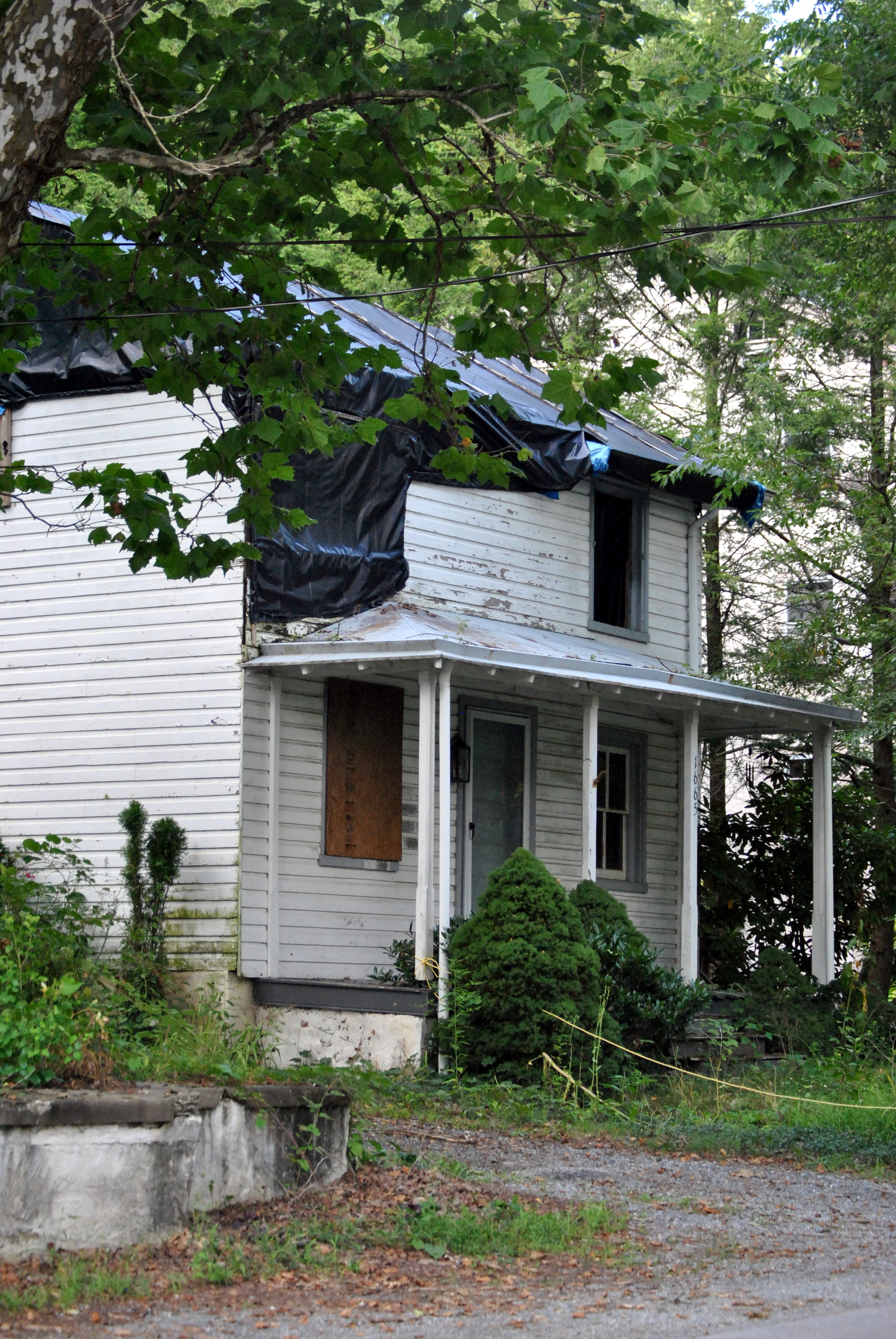
I dug a little more and this is what Historic Yellow Springs has to say on it’s website today even as Vaughn house is all boarded up and half covered by tarps:

Connie’s, Vaughn, Jenny Lind, and Yeaworth Houses

Connie’s House dates to the late 1800’s and was originally a post office and general store. It is now owned by the Chester Springs Studio and is used for exhibitions and artists’ residencies. The building was given to the Studio by Yellow Springs Founder Connie Fraley, hence the affectionate name. The Vaughn House, named for its last resident, is a charming small farmhouse built in the 1830’s. Historic Yellow Springs completely restored the house in 1989 and it serves as a tenant residence.

Mrs. Holman, the retiring owner of the Yellow Springs Spa property, built the Jenny Lind House in the early 1840’s as a boarding house – it has eight bedrooms!

The Yeaworth House, also named for its last resident, was built in 1899 as an infirmary for the Soldiers’ Orphans School. It was converted to a residence in the 1950’s, extensively renovated in 1987-88, and now serves as another tenant residence.

The English actress Fanny Kemble describing her visit to Yellow Springs during July 1843 in her book Records of Later Life, 1882:

“This morning the children took me up a hill which rises immediately at the back of the house (the Jenny Lind House), on the summit of which is a fine crest of beautiful forest trees, from which place there is a charming prospect of hill and dale, a rich rolling country in fine cultivation – the yellow crops of grain, running like golden bays in the green woodland that clothes the sides and tops of all the hills, the wheat, the grass, the variegated patchwork covering of the prosperous summer earth.”

Vaughn House is no charming tenant property now.  I took a good look at it on Sunday.  It is a wreck after a fire, and how embarrassing that Historic Yellow Springs can’t be honest about it.

I dug around and was told Historic Yellow Springs  did collect insurance post-fire,but it was not enough to effect historic preservation repairs.   Given the June 2012 meeting minutes I quoted above, I would say they are in a fair pickle when it comes to this property.

Someone I know who looked at the house recently said it was not beyond redemption but would be soon if they did not get busy.
The irony is everyone knows there is some serious money in and around Yellow Springs, so why can’t some of those people rescue this house and preserve it?  What happened was a tenant fire, I am unsure of the timeline, but I noticed on West Pikeland’s website a last name that is the same as that general store, or Harold M. Hallman III.   From what I have been told years ago, this family has been around forever and own a lot of land?  Couldn’t a family like this help Historic Yellow Springs?

See this is what I do not get about this place: those who can’t don’t.

Yellow Springs has an amazing history and still has three mineral springs: magnesium, sulphur, and iron.  The whole village grew up around the medicinal value of these springs. There are references to them in Colonial Times and Washington hung out there…and they can prove it.  People used to travel up the Schuylkill by packet boat from Philadelphia to Pottstown/Phoenixville and then by coach to the Inn for taking the waters in the springs.

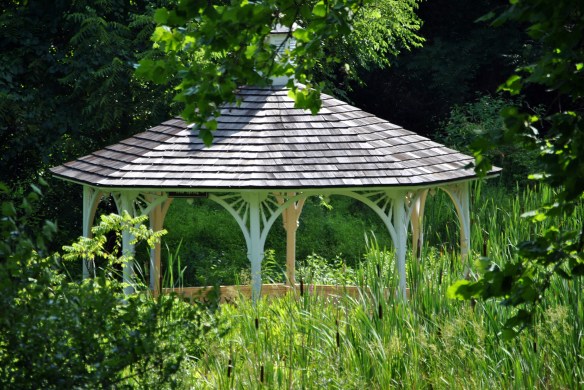
On their website, the iron spring gazebo is in a field neatly cut.  It is practically drowned by brush and rushes right now.  There used to be these amazing walking trails that you could take to check out the springs.  I could not see any of the trails this weekend, as things are that overgrown.

I totally get Historic  Yellow Springs  currently seems to be  swinging toward a more public revenue stream with using the village for  weddings, rentals,  and sponsored events. I have done enough work with small non-profits to know non-profit funding is there but grantors want specific results over the long-term.  However, when I say the place needs donor angels I am not kidding.  They are advertising the old inn “The Washington” as being event ready, and maybe it is o.k. but I have heard from people who inquired that you have to bring in a kitchen to do an event, there is no longer a kitchen. That adds significantly to what you have to rent.

This place is like a ghost town now.  The life comes from the restaurant in the Jenny Lind House, The Yellow Springs Inn.  But that is privately owned, and the care taken to do a restoration there is obvious.  So should Historic Yellow Springs consider selling some of the properties provided they can ensure they can, and will be preserved?

This is the list of HYS board members as per their website and if it is not current that is their issue:

Mark Ashton, President

Anne M. Congdon

Stephen P. Cottone

Polly Gable, Secretary

Karin E. Gedge

Rita Kaplan

William LaCoff, Vice President

Edward A. Meltzer, Treasurer

Terri Moran

Moira Mumma

Matthew E. Roberson

Brendan J. Sherman

Robert C.F. Willson

I do not know any of these people but is this board active?  Or are they a board that treats their non-profit as a private club?

Here is the staff list:

Heidi Brett, Arts Program Manager – 610-827-7414 ext. 16 hbrett@yellowsprings.org
Callie McGlone, Office and Events Manager – 610-827-7414 ext. 10   cmcglone@yellowsprings.org

Eileen McMonagle , Executive Director – 610-827-7414 ext. 14 emcmonagle@yellowsprings.org

Sandra S. Momyer, Moore Archivist – 610-827-7414 ext. 19 smomyer@yellowsprings.org

Diane Peterson, Business Manager – 610-827-7414 ext. 17       dpeterson@yellowsprings.org

John Shaw, Volunteer Coordinator jshaw@yellowsprings.org

I have been told the Executive Director is fairly new and very nice and really into preserving the historic village.  Maybe they need some new board members then?

The history from the springs, the Revolutionary War Hospital, the who artist colony history makes Yellow Springs cool.  But it does not matter how many volunteers it has if no movement is occurring.

They used to do so many events, and that has dwindled.  You need events to bring people to town, not just putting the event for rent sign out on the village.  Bring back the antiques show, for example.  That drew thousands to the village.

They could host re-enactment events.  There are tons of people who live to come to these things in correct period costume and share their knowledge of particular periods in United States History – I have seen it at places like Historic Goshenville.  I have seen it at various Civil War re-enactments.  Also things like Farmers’ Markets will draw people to a community – look no further than the markets we all go to every week in Chester County during growing seasons. Or flower shows.  Or old-fashioned things like quilt shows.  Open air antiques and crafts markets.  Partner with local farms for farm table dinners in the Village or haunted hay rides in the fall. People love those too. There are a lot of things that can be done, but the people controlling this historic village need to want to do things to better the lot of the village.
And what can the West Pikeland Township people do that is positive for the village to encourage and entice people to support the village.

I know so many areas that would kill to have history like this.   Don’t squander it Historic Yellow Springs.   People care about the village.  I watched a guy cutting really long grass just to make things look better.  I asked someone if he worked for the township.  The answer was no, he is just a resident who cares about the land.

Look at the historic homes inventory in and around Yellow Springs Village. (Mind you one thing I found interesting on that list was the 1083 Bodine Road owned by The Barnes Foundation.)

If Chester Springs is supposed to be one the most affluent sections of Chester County, then I wish some of them would wake up and see that Historic Yellow Springs gets a shove.

No one wants to write a donation check in this economy that is not going to be accounted for, I get that.  So what about targeted donations?  Or very specific fundraising efforts?  Like how much needs to be raised to restore Vaughn House?

What kind of special events (not just recurring ones)  can the board of Historic Yellow Springs bring to the Village?  If those people want to sit on the board then are they responsible for helping raise a certain dollar amount in donations?  Face it, this place needs not only an active board, but a proactive board.  And if these board members aren’t bringing in a certain amount of donations each year, or giving it themselves, they need that board freshened up a little more often.  Who can they partner with in neighboring communities or other areas of historic interest to raise awareness?

And the walking trails.  People love walking trails, especially when there is not only beauty, but a lot to look at.  And face it, those springs are still cool a couple of hundred years later!  But the trails seem to be lacking maintenance.  Why not invite boy scout troops from Chester County to adopt the trails as service projects?  Maybe let them camp once in a while  in one of the fields like the one being used for parking of studio vehicles.

O.k. rant over.  Sorry, but I think this is worth saving and the people in control do have the tools to do so.  Only I can’t figure out what they are waiting for.

this old house

In March, I put up a post about one of the many old houses falling to crumble and ruin in Chester County…along Route 30. 

Thanks to Pete Kennedy of Malvern Patch I now know…It is a home formerly known Linden Hall (used to have Linden trees – one of my late father’s favorite trees), once owned by a family named Paulovich.

Also…according to eastwhiteland.org it was also know as “Wayne Tavern”.  Like Loch Aerie, which I have written about twice and photographed, East Whiteland ironically lists this home as a historical site on their website.  Apparently they value these structures, only they don’t seem to push them towards permanent preservation?

At the risk of being repetitive, I will close with what I said in March –

Chester County needs to put some thoughts into their commercial corridors don’t they?  It’s not like the location is suited for residential, yet here and there these old houses sit and rot.  Some have sale signs on them, some are just rotting away by themselves.

What can be done with old buildings like this?  I am a realist and know full well that not every old house should be saved.  But some should.   And Chester County needs better planning in their commercial corridors.  Man  cannot live by strip mall alone……

calling all preservationists and angels: historic st. peter’s church needs you!

It is a horrible economic time to have a crisis with a historic structure, let alone one of the most favorite and beloved in the Philadelphia region.  It is because of that this blog is making a little side trip to the Society Hill section of Philadelphia where I was born.

St. Peter’s, is an 18th century, American Revolution relevent Episcopalian Church in Society Hill and 4th and Pine streets.  I went to grade school at St. Peter’s School, so I have many happy memories of this church (and others like getting a book autographed every year at the St. Peter’s book fair by Marguerite D’Angeli who was a friend of the headmistress.)

St. Peter’s was one of the Society Hill landmarks that was my playground as a child.  It is also one of the most beautiful and serene places in Philadelphia.

I attended Easter Services at St. Peter’s and it was like instantly going back in time to when I was a little girl.  St. Peter’s is one of those places that makes you realize you can go home again.  From her beautiful windows to the high boxes inside the church, to the climb up the stairs for a look out over the church yard, St. Peter’s is just a very cool place.

I learned on the news today that St. Peter’s needs the help of anyone who can spare a dollar or two.  The church is being forced to close due to instability in the roof of the historic structure.  St. Peter’s Church was designed by Robert Smith and opened in 1761 as an offshoot of Christ Church in Old City. The Church’s tower, designed by William Strickland, was added in 1842.

St. Peter’s is a National Historic Landmark.

Saint Peter’s is not just a historic structure, it is a church that does many good things including a food cupboard.  They live their slogan of “Open Hearts. Open Minds”

Can you help save St. Peter’s?  The faster they have angels drop donations on them, the faster they will reopen.

Donations of any amount can be sent as follows:

Saint Peter’s Church, ATTENTION: HISPIC,313 Pine Street Philadelphia, PA  19106

 Media on the topic:

Plan Philly: St. Peter’s Church roof at risk of collapse

St. Peter’s Church at 3rd and Pine streets has been in continuous use since the 1760s, but parishioners will not be able to worship in the sanctuary this Sunday.

The Inquirer reports that St. Peter’s sanctuary roof is at risk of collapse. An engineering firm reportedly inspected the sanctuary’s roof trusses and found their condition dangerous enough to order the building closed until stabilization measures can be completed.

WHYY Newsworks: With roof in danger of failing, historic Philly church takes sabbatical  May 17, 2012  By Kevin McCorry

Philadelphia Inquirer: Sanctuary of St. Peter’s Church closes amid fears of collapse

May 16, 2012|Bob Moran